Summary: Executive Assistant vs Personal Assistant
- A Personal Assistant (PA) manages personal logistics for one individual - scheduling, errands, travel bookings, and inbox management - with an average US salary of $48,191/year (ZipRecruiter, 2026).
- An Executive Assistant (EA) manages business operations for 1–5 executives - calendar strategy, stakeholder communication, and project coordination - with an average US salary of $72,089/year (Indeed, 2026).
- The key difference is scope: a PA handles personal support, an EA delivers strategic business leverage. Shared skills across both roles include calendar management, communication, confidentiality, and organization.
- Hire a PA if personal errands and routine admin consume your time. Hire an EA if business operations are the bottleneck limiting your growth.
A personal assistant handles personal life logistics, travel bookings, household errands, inbox management, and daily scheduling for 1 person's entire personal and professional life.
An executive assistant handles business-level strategic support, calendar strategy, stakeholder communication, project coordination, and C-suite operations, typically supporting 3–5 executives simultaneously. Here is exactly when you need each.
Key Differences Between Personal Assistant and Executive Assistant
| Factor | Personal Assistant (PA) | Executive Assistant (EA) |
|---|---|---|
| Scope | Personal tasks & errands | Business operations & strategy |
| Works for | 1 individual | 1–5 executives |
| Avg. US salary | $48,191/year | $72,089/year |
| Decision-making | Task execution | Independent judgment |
| Seniority | Entry level | Senior level |
| Level of responsibility | Personal & admin | Strategic & operational |
| Business context | Personal/household | Corporate/founder-led |
| Type of work | Reactive, task-based | Proactive, judgment-based |
| Impact on scale | Individual efficiency | Business growth |
| Best for | Personal bottlenecks | Business growth constraints |
This blog will help you figure out which one you actually need, or whether to hire a virtual executive assistant and skip the guesswork entirely.

What Is a Personal Assistant? Roles & Responsibilities
A personal assistant manages the personal and administrative layer of one individual's life, handling travel bookings, household errands, inbox management, appointment scheduling, expense tracking, and daily schedule coordination across both personal and professional contexts.
A personal assistant will have to take care of the family needs, in addition to assisting their boss with day-to-day business work. You can expect a PA to be responsible for running household errands. They work on things that make the life of their boss easier.
In the United States, Personal Assistants earn an average annual salary of $48,109 or $$23.13 per hour.
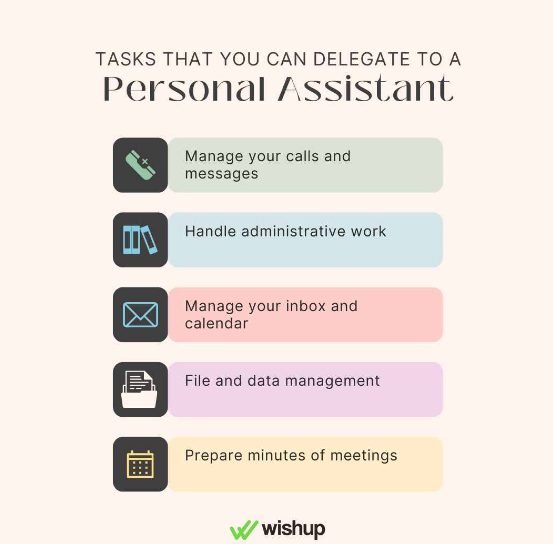
Personal assistants handles a wide range of tasks and responsibilities. These include the following:
- Manage calendar and daily schedule
- Make arrangements for domestic and international travel as and when needed
- Manage inbox and draft responses, flag emails, and handle communications when needed
- Book appointments and make reservations
- Prepare and distribute memos
- Manage budgets and expenses
- Handle 5–10 weekly personal tasks and errands including grocery orders, reservations, household vendor coordination, and family scheduling.
- Draft reports, presentations, and other business documents
Hiring a personal assistant recovers an average of 10+ weekly hours spent on personal logistics, errands, and routine admin.
Hire a virtual personal assistant from Wishup.
What Is an Executive Assistant? Roles & Responsibilities
An executive assistant manages the business operations layer of a senior leader's workload, handling calendar strategy, stakeholder correspondence, project coordination, travel logistics for business trips, meeting preparation, and cross-team communication on behalf of 1 to 5 executives in a corporate or founder-led environment.
You have many responsibilities and tasks to manage daily as a business owner. That's where an executive assistant can come in handy.
An executive assistant provides administrative support to executives and CEOs. They act as the right-hand person to the executive. They help ensure the smooth operation of the business.
Get 3 of your toughest business operations automated by our VA
1 month complimentary. Your VA works inside the tools you already use — no migration, no disruption.













Helped 982 founders save 40+ hours every week
★★★★★ Trusted by founders worldwide
Here are some of the primary tasks that an executive assistant may perform:
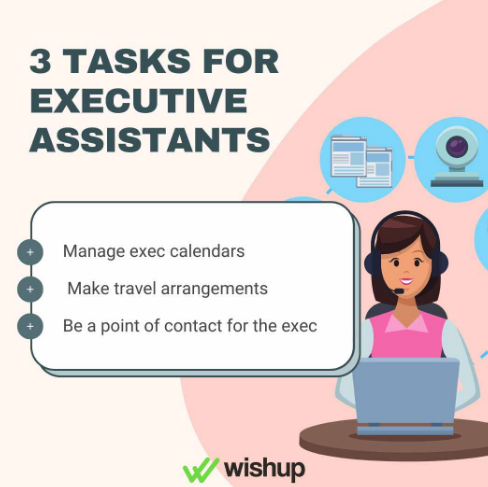
- Calendar management: Scheduling appointments, meetings, and events for the executive. Ensuring that the executives are on time and well-prepared.
- Travel arrangements: Booking flights, hotels, and rental cars for business trips and conferences. Ensuring that all necessary travel documents are in order.
- Correspondence: Respond to emails and phone calls on behalf of the executive. Drafting letters and other documents as needed.
- Project management: Coordinating projects and deadlines. Working with other team members to ensure that tasks are completed on time.
- Research: Research various topics. This includes market trends, industry news, and potential business partners.
- Administrative tasks: Performing various administrative tasks, such as filing, data entry, and record-keeping.
In the United States, the typical annual salary for an Executive Assistant stands at approximately $72,809.
An executive assistant manages the 15+ weekly hours of operational work, calendar coordination, meeting prep, and stakeholder communication that would otherwise fall on the executive directly.
They provide valuable support to executives. Allowing them to focus on strategic planning and decision-making. While handling many of the day-to-day tasks that keep a business moving forward.
Differences between Personal Assistant and Executive Assistant
The 5 core differences between a personal assistant and an executive assistant are scope of work, seniority level, decision-making authority, salary range, and the type of tasks they own, with PAs focused on personal life management and EAs focused on business operations leverage.
Scope of work
PA: Personal tasks, errands, and basic admin for 1 person.
EA: Business operations, project coordination, and stakeholder management for 1–5 executives
Seniority and experience
PA: Entry-level position requiring organizational skills.
EA: Senior-level position requiring business judgment, discretion, and tool proficiency
Classification by seniority level:
- Personal Assistant - commonly supports Directors, VPs, and mid-level managers handling both personal and professional tasks
- Executive Assistant - supports C-suite executives (CEO, COO, CFO) and senior leadership, operating at a strategic business level
- PA to the CEO - a hybrid role combining EA-level business support with personal logistics, typically found in founder-led or small executive teams
Decision-making authority
PA: Task execution following direct instruction.
EA: Proactive anticipation of needs, independent prioritization, and judgment calls
Salary range
PA: $48,109/year average.
EA: $72,809/year average, reflecting the higher strategic value delivered
Primary environment
PA: Personal and household context, directly serving one individual.
EA: Corporate or founder-led business context, supporting executive-level operations.
As a business owner, it is vital for you to understand these differences. So that you can hire the right person who fits your exacting needs, you can read more about personal assistant vs executive assistant by clicking this link.
Similarities Between a Personal Assistant and Executive Assistant
Executive assistant vs personal assistant has similar roles in supporting and assisting their bosses. But there are some differences in the level of responsibilities and the scope of their work. Here are three significant similarities between the two:
Schedule and calendar management
Both PAs and EAs own their boss's calendar, coordinate appointments, and ensure deadlines and commitments are met without conflicts
Communication and stakeholder handling
Both roles require clear written and verbal communication with clients, colleagues, and external parties, including handling sensitive or high-stakes conversations
Confidentiality and information security
Both PAs and EAs handle sensitive personal and business information, requiring verified trustworthiness, signed NDAs, and documented discretion protocols
While there are differences in the level of responsibilities and scope of work, there are several significant similarities between personal assistant and executive assistant roles. Both types of assistants play a crucial role in ensuring their bosses' success. Their skills and abilities are vital to the smooth running of any business.
The pros and cons of hiring a Personal Assistant
Personal Assistants help you with tasks and manage your schedule. Here are some pros and cons to consider before making the decision.

Pros:
Increased Productivity: A personal assistant helps you schedule appointments, answer emails, and organize paperwork. You can focus more on your core business responsibilities and be more productive.
Improved Time Management: A personal assistant can manage your schedule. They remind you of appointments and deadlines. This ensures that you don't miss important meetings or events.
Enhanced Efficiency: Delegating tasks to your personal assistant increases the overall efficiency of your business.
Cost-Effective: Hiring a personal assistant may be more cost-effective than hiring extra full-time employees. Especially if you only need assistance for a limited amount of time.
Cons:
Cost: Hiring a personal assistant may be costly, especially if you're looking for someone with experience and a specific skill set.
Lack of Control: You may need to relinquish some control over your schedule and tasks. As your personal assistant will be managing your calendar and organizing your work.
Training Time: Depending on the level of experience of your PA, there may be some time required for training and onboarding, which can be a time-consuming process.
Privacy Concerns: Sharing personal and confidential information with your personal assistant causes privacy concerns. Especially if the assistant is not vetted or trustworthy.
Hiring a personal assistant improves productivity and time management. It betters efficiency in your business operations. It's important to weigh the pros and cons carefully. Then consider whether a personal assistant is the best option for you or not.
The pros and cons of hiring an Executive Assistant
Executive assistants help you take care of administrative tasks. But should you hire an executive assistant? Here are some pros and cons to consider:
Pros:
Increased productivity: With an executive assistant, you can delegate tasks that take up a lot of your time. This will allow you to focus on your core responsibilities. This can help increase the productivity and efficiency of your business.
Time management: An executive assistant can help you manage your time better. This is done by scheduling meetings, appointments, and tasks on your behalf. This allows you to focus on your work and stay on top of your schedule.
Improved communication: An executive assistant can help improve communication within your business. They can act as liaisons between you and your team, clients, and stakeholders. This can help prevent miscommunication and ensure everyone is on the same page.
Cons:
Cost: Hiring an executive assistant can be expensive, especially for small business owners. You will need to pay for their salary, benefits, and possibly even their training.
Dependency: You might become dependent on your executive assistant if you rely too much on them. This can make it difficult for you to manage your schedule and tasks. It can also make it difficult for you to function without them.
Trust issues: Trusting someone else to handle important tasks for your business can be difficult. You will need to find someone you can trust, which can take time and effort.
Hiring an executive assistant can have many benefits for your business. However, it's important to weigh the pros and cons before making a decision.
Which one should you go for: Personal Assistant vs Executive Assistant review?

Hire a personal assistant when personal errands, household coordination, and basic admin consume more than 10 hours per week of your time.
Hire a virtual executive assistant when business operations, stakeholder communication, calendar strategy, and project coordination are the bottleneck preventing you from working at a strategic level.
Two types of assistants you might consider are personal assistants and executive assistants.
Personal assistants focus on more personal tasks. They help you with things like scheduling appointments, booking travel, or running errands. Personal assistants can be a great choice if you need help with tasks that take up a lot of your time. PAs must have a lot of specialized knowledge or expertise.
Executive assistants are more focused on helping you manage your business. They may help you with tasks like managing your calendar and coordinating meetings. They are good at handling administrative tasks. Executive assistants are highly skilled professionals. They help you manage complex tasks and stay organized in a fast-paced business environment.
It's important to consider your specific needs and goals. When deciding whether to hire an executive vs personal assistant. If you need help with more personal tasks, a personal assistant may be your best choice.
An executive assistant may be a better fit if you need to manage your business and stay organized. The choice will depend on your specific needs and the level of support you must achieve your goals.

Why a Virtual Executive Assistant Delivers More Leverage Than a Hire
For most founders and CEOs comparing an in-house EA versus a virtual EA from Wishup, the cost-to-leverage calculation is clear.
An in-house executive assistant at the US average of $72,809/year comes with additional costs: benefits, office space, onboarding time of 2–4 weeks, and a replacement cycle averaging 50–200% of salary if the hire doesn't work out.
A virtual executive assistant from Wishup starts at $1,299/month, pre-vetted from the top 0.1% of applicants, pre-trained across 70+ tools including Notion, Asana, HubSpot, and Google Workspace, and operational in 60 minutes. If the fit isn't right, Wishup's free replacement guarantee eliminates the rehiring risk entirely.
For operators who need strategic business support without the overhead of a full-time employee, hire a virtual executive assistant.
How Wishup can help to hire a Personal Assistant or an Executive Assistant
It's essential to have a reliable and competent personal assistant or executive assistant. They will help manage your workload and keep your day organized.
That's where Wishup comes in. Our executive assistant and personal assistant services provide top-tier support for entrepreneurs.

Wishup's executive assistant and personal remote assistant services offer business owners a reliable and competent support system. This helps to manage your workload and keep your day organized. Wishup is the perfect solution for busy professionals looking to delegate tasks and maximize their time.

Conclusion
Hiring an executive assistant, or a personal one, can be a game-changer for business owners. The key is to determine the specific needs of your business. And then choosing the right type of assistant accordingly. By keeping in mind the differences and benefits of each type, you can make an informed decision that suits your budget and requirements.
If you're looking for a reliable and professional personal vs executive assistant, Wishup can help. Our online assistant services are designed to cater to the needs of business owners.
We provide a range of benefits, such as cost-effectiveness, flexibility, and round-the-clock support. With Wishup, you can streamline your business operations. You can increase productivity and focus on what matters most, growing your business.
If business operations are limiting your growth, a virtual executive assistant from Wishup is the faster, more leveraged hire: pre-vetted from the top 0.1% of applicants, trained in 70+ tools, and onboarding in 60 minutes from $1,299/month.
If personal logistics are consuming your time, a virtual personal assistant covers that layer at the same starting price.
Either way, the first 60 minutes of working with a Wishup VA typically recovers more time than the onboarding took.
FAQs
1. How to hire a personal assistant?
Hire a personal assistant through a managed VA agency, the fastest path, or through direct in-house recruitment.
Wishup onboards a pre-vetted virtual personal assistant in 60 minutes using a 3-step process: free consultation call, talent matching from the top 0.1%, and same-day onboarding.
First, outsourcing from an agency like Wishup or hiring through in-house recruitment is a good idea.
Steps to follow:
- Schedule a call. Mostly, all these calls are free with agencies.
- When you schedule a call with the agency, you must share a detailed list of the specific skills, responsibilities, and experience levels you're looking for in a personal assistant.
- The agency will find you a match among its top talents within the stipulated time. At Wishup, we hire only the top 0.1% of talent.
- Make the payment.
- Finally, onboard your assistant.
Wishup can help you onboard a virtual personal assistant in just 60 minutes.
2. What is the role of a personal assistant?
A personal assistant manages the daily logistics of one individual's personal and professional life, coordinating travel, maintaining the calendar, handling inbox communications, running errands, and organizing schedules so the individual operates without friction.
While personal tasks include running household errands. Professional tasks include organizing and coordinating the day-to-day schedule, including appointments, meetings, and travel arrangements.
A personal assistant helps keep individuals organized and on schedule at all times.
3. What are the duties of a personal assistant?
Duties of a Personal Assistant:
- Organizing flights, accommodation, and transportation for business and personal trips
- Keeping track of appointments, meetings, and deadlines
- Creating documents for meetings, projects, and updates
- Organizing meetings and documenting minutes of meeting
- Tracking and submitting expenses for reimbursement or accounting
- Gathering information and accurately transcribing spoken words
- Communicating with clients, suppliers, and other important contacts
- Overseeing and updating the boss’s calendar to avoid scheduling conflicts
- Ensuring the boss stays on time and prepared for all commitments
- Answering phone calls and responding on behalf of the boss
- Collaborating with other support staff to ensure smooth operations
- Drafting and sending letters, emails, and other communications.
- Providing administrative support
- Maintaining discretion and confidentiality of sensitive information
4. What is the difference between an executive and a personal assistant?
The core difference is context: an executive assistant operates inside a corporate environment, supporting 1–5 C-suite executives on business operations. A personal assistant works directly with one individual on both personal and professional tasks, with no corporate scope requirement.
Executive vs personal assistant roles involves providing administrative support. The main difference is that an executive assistant works in a corporate environment. They support a top-level executive. While a personal assistant works directly with an individual. They may be required to perform both professional and personal tasks.
5. What is the difference between an executive PA and PA?
An Executive PA handles more complex, high-stakes responsibilities than a standard PA, including C-suite calendar strategy, board-level correspondence, and cross-departmental coordination, while a standard PA focuses on personal logistics and routine admin for one individual.
An Executive PA is a specialized PA who provides administrative support to high-level executives, such as CEOs, presidents, or senior managers. Executive PAs handle more complex tasks and have greater responsibilities than regular PAs.
The main difference between a PA and an Executive PA is the level of responsibility and the types of tasks they handle.
6. Can an executive assistant do personal tasks?
Yes, an executive assistant can do personal tasks. But it depends on the company's policies and the specific job description. Some executive assistants are solely responsible for managing the executive's professional life. While others may also handle personal tasks.
An executive assistant performs personal tasks when the job description explicitly includes them, the scope is defined at hiring, not assumed. Yet, if it's not specified in their job description, they may still be willing to help with personal tasks if their workload permits.
7. What is the difference between a personal assistant and a secretary?
A secretary handles office-based administrative tasks — answering phones, filing, managing correspondence, and supporting an entire office or department. A personal assistant works exclusively for one individual, managing both personal and professional responsibilities with a broader, more flexible scope than a secretary.
8. What is the difference between an executive assistant and an executive secretary?
An executive secretary focuses on formal correspondence, meeting documentation, and office coordination. An executive assistant goes beyond administration — managing calendars strategically, handling stakeholder relationships, coordinating projects, and acting as a decision-making proxy for the executive. The EA role carries significantly more autonomy and business judgment than an executive secretary.
